Migration from Copper/ISDN PRI to SIP Trunk Services
Telecommunication providers such as TM, Maxis, CelcomDigi, and TIME are progressively phasing out traditional copper lines and ISDN PRI services. The ageing infrastructure has become increasingly expensive to maintain and is less reliable compared to modern fibre-based networks.
The introduction of TM MLS (Multi-Line SIP), together with SIP Trunk services from Maxis, CelcomDigi, TIME, and REDtone, represents the telecommunications industry's transition from legacy copper infrastructure to fibre-based IP voice services. This migration enables service providers to reduce operational costs while delivering improved service quality, higher reliability, and greater scalability.
Understanding TM MLS (TM Multi-Line SIP)
A common misconception is that TM MLS operates as SIP over the public Internet. This is not correct.
TM MLS is delivered over TM's own carrier-grade network, specifically its IMS (IP Multimedia Subsystem) and MPLS backbone, which is purpose-built for business telephony. This private network provides guaranteed Quality of Service (QoS), enhanced security, and predictable network performance.
Although SIP signalling is IP-based, TM MLS is typically delivered through one of the following controlled access methods:
- TM's private MPLS network
- Dedicated fibre circuits
- TM-managed Ethernet services
- TM Business Broadband with controlled routing into TM's IMS network
In these deployments, SIP traffic remains within TM's managed network and is not exposed directly to the public Internet.
Firewall and Session Border Controller (SBC) Requirements
Because TM MLS operates within TM's private managed network, it is generally not necessary to deploy a Session Border Controller (SBC) or additional firewall solely for the SIP trunk, provided that:
- the SIP trunk communicates only with TM's network;
- the PBX is not directly accessible from the public Internet; and
- SIP endpoints (IP phones and clients) remain within the organisation's private network.
Some telephony vendors recommend deploying an SBC for every SIP trunk implementation. While SBCs have important applications in certain environments—such as Internet-based SIP services, multi-site deployments, SIP federation, or remote users—they are not a mandatory requirement for a standard TM MLS deployment operating entirely over TM's private carrier network.
SIP Trunks from Other Service Providers
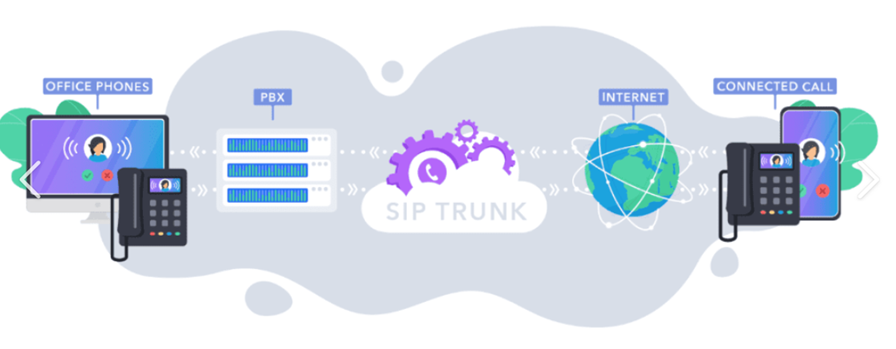
Unlike TM MLS, SIP Trunk services from providers such as Maxis, CelcomDigi, TIME, and REDtone are commonly delivered via the public Internet.
In these deployments, appropriate security measures should be implemented, including:
- Deploying a firewall to restrict and whitelist authorised SIP provider IP addresses.
- Performing proper Network Address Translation (NAT) and port forwarding between the public IP address and the internal PBX.
- Following security best practices to prevent unauthorised SIP access and toll fraud.
Depending on the deployment architecture and security requirements, an SBC may also be considered for additional protection and interoperability.
Existing PBX Systems Can Continue to Be Used
Migrating from ISDN PRI or analogue trunks to SIP does not necessarily require replacing your existing PBX system.
In many cases, the existing PBX can continue to operate by installing a SIP-to-PRI or SIP-to-Analogue gateway. The gateway acts as the interface between the service provider's SIP Trunk and the existing PBX, allowing organisations to migrate to fibre-based telephony while preserving their current investment in PBX equipment.
This approach provides a cost-effective migration path, enabling businesses to adopt modern SIP services without the expense and disruption of a complete PBX replacement.