A broadcast storm in a VoIP network happens when broadcast or multicast packets multiply uncontrollably, consuming bandwidth and CPU on switches, phones, and PBX servers—causing call drops, one-way audio, registration failures, or total network outage.
When I was first onboard in a conglomerate organization, there was a major broadcast storm occurred and the whole hotel's phones failed floor by floor. What is a broadcast storm and why it happens?
What is a broadcast storm ?
A broadcast storm occurs when:
- A broadcast packet is repeatedly forwarded
- Devices keep re-broadcasting the same traffic
- The network becomes saturated with ARP, DHCP, SIP, LLDP, STP, or multicast packets
Result:
- Phones can’t register
- RTP audio breaks
- PBX becomes unreachable
How broadcast storms happen in VoIP networks
1️⃣ Network loop (MOST COMMON cause)
This is #1 in real VoIP deployments.
How it happens
- Two switches connected with multiple paths
- No STP (Spanning Tree Protocol), or STP misconfigured (this is what happens in my scenario)
- Someone plugs:
- LAN → LAN between switches
- Phone PC-port → wall socket
- Switch → switch → switch loop
What happens
- Broadcast packet enters loop
- Switch floods it endlessly
- Traffic grows exponentially
VoIP impact
- SIP REGISTER packets never reach PBX
- Phones reboot or freeze
- Call setup fails immediately
Below is a clear BEFORE / AFTER diagram showing how STP (Spanning Tree Protocol) stops a VoIP broadcast storm
BEFORE: STP Disabled (Broadcast Storm)
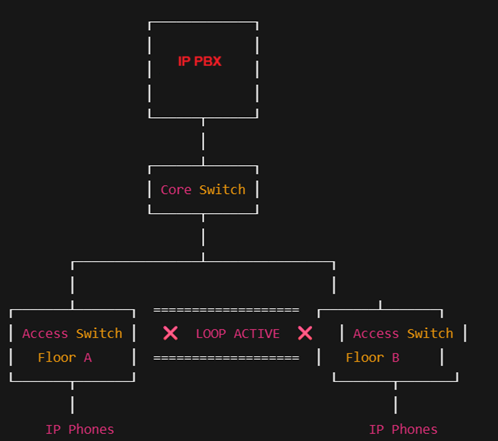
What happens
- Broadcast packet enters loop
- Switches flood it back and forth
- Traffic multiplies infinitely
- VoIP collapses first
AFTER: STP Enabled (Loop Prevented)
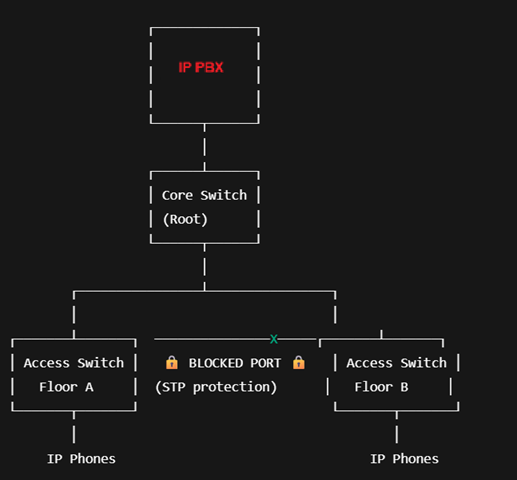
What STP does
- Elects a Root Switch (usually Core)
- Calculates shortest path
- Blocks one redundant link
- No broadcast loop possible
✔ Traffic flows normally
✔ Phones register successfully
✔ Calls are stable
What “wrong STP configuration” usually means (real cases)
1️⃣ Wrong STP root bridge
Most common mistake
What should happen
- Core / distribution switch = STP Root
- Access switches = non-root
What went wrong
- An access switch or even a small PoE switch became the root bridge
- Traffic paths become unpredictable
VoIP impact
- SIP packets take longer paths
- Random jitter, registration drops
- Storm happens when a new link is added
Management-Level Explanation
The recent VoIP disruption was caused by a network configuration issue, not by the phone system or server itself.
The internal network has a safety mechanism designed to prevent network traffic from circulating endlessly. Due to an incorrect configuration, this protection did not work as intended. When a redundant network connection was present, traffic began circulating repeatedly, overwhelming the network.
Because voice calls are very sensitive to network delays, the phone system was the first service to be affected. As a result, IP phones were unable to register properly, calls dropped, and audio quality was impacted.
Once the configuration was corrected, the network returned to normal and the phone system stabilized immediately.
Key Points for Management
- The issue was network-related, not a VoIP system failure
- No hardware failure or cyberattack was involved
- The problem was triggered by a configuration error, not daily operations
- Voice services are more sensitive, so they showed the impact first
- Preventive controls have now been identified to avoid recurrence
Risk & Prevention Summary
To prevent similar incidents in the future:
- Network safety settings will be standardized
- Redundant connections will be properly controlled
- Additional safeguards will isolate faults to a single device instead of affecting the whole system
These measures significantly reduce the risk of a full service outage going forward.